Introduction to the South African Service Economy
The demand for professional field services in South Africa-ranging from specialized HVAC maintenance to renewable energy installations-is projected to reach new heights in 2026. However, moving from an idea to a fully operational entity requires more than just technical skill; it requires a deep understanding of local regulatory frameworks and digital efficiency.
In this guide, we break down the essential steps to start a service business in South Africa, ensuring you build a foundation that is both legally compliant and commercially scalable.

Step 1: Formalizing Your Entity through CIPC Registration
Before you can issue your first invoice, you must formalize your business. In South Africa, this begins with the Companies and Intellectual Property Commission (CIPC). Most service entrepreneurs opt for a Private Company (Pty) Ltd structure because it offers limited liability and a professional image.
Key considerations for 2026:
- Name Reservation: Choose a name that reflects your service and isn't already in use.
- Director Appointment: Ensure directors have valid South African IDs or foreign passports with required permits.
- Official Address: You must provide a physical address where your business records will be kept.
Once registered, you will receive a CoR 14.3 registration certificate, which is essential for opening a business bank account and registering for tax.
Step 2: Navigating Tax and BEE Compliance
Compliance is a competitive advantage in South Africa, particularly when bidding for corporate contracts or government tenders. You must register with SARS for Income Tax immediately. Depending on your projected turnover, you may also need to register for Value Added Tax (VAT) if you expect to exceed R1 million in annual revenue.
Broad-Based Black Economic Empowerment (BEE)
BEE compliance is critical. For new start-ups with an annual turnover of less than R10 million, you qualify as an Exempted Micro Enterprise (EME). You don't need a full audit; a sworn affidavit is sufficient to confirm your BEE level. This document is vital for doing business with larger entities that prioritize procurement from empowered suppliers.
Step 3: Industry-Specific Field Service Licensing
Depending on your niche, you may require specific field service licensing. In South Africa, specialized work is governed by various bodies to ensure safety and quality standards:
- Electrical: Must be registered with the Department of Employment and Labour and potentially the Electrical Conformance Board (ECB).
- Plumbing: Registration with the Plumbing Industry Registration Board (PIRB) is highly recommended.
- Construction: Registration with the CIDB (Construction Industry Development Board) is mandatory for public sector work.
- Security: All security-related services must be registered with PSiRA.
Step 4: Developing a Tech-First Business Plan
A modern business plan for 2026 must account for digital transformation. Traditional manual scheduling is no longer viable in a competitive market. Your plan should outline:
- Market Analysis: Who are your South African competitors and what is your unique value proposition?
- Financial Projections: Consider the costs of vehicles, specialized tools, and insurance (Public Liability is a must).
- Operational Strategy: How will you manage your team in the field?
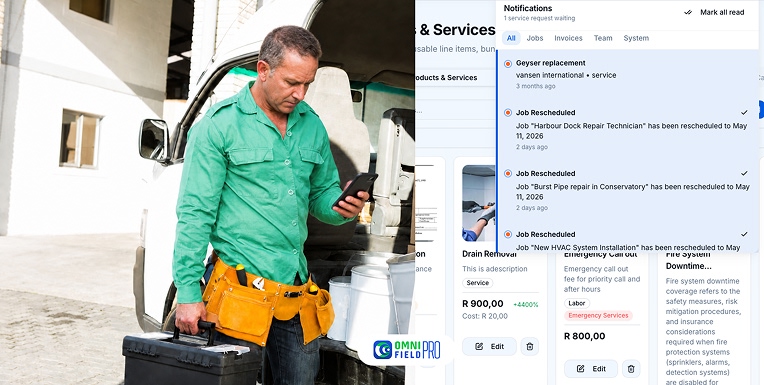
Efficient businesses use Field Service Management (FSM) software like Omni Field from day one to automate job cards, tracking, and invoicing, ensuring that cash flow remains healthy.
Step 5: Launching and Scaling
With your CIPC documents in hand and your BEE affidavit ready, it's time to build your brand. Leverage local SEO and digital platforms to reach South African homeowners and businesses. Focus on high-quality service delivery and use digital tools to capture customer feedback immediately after a job is completed.
As you scale, prioritize skills development and employment equity to maintain your BEE status and contribute to the South African economy. By combining solid legal foundations with modern technology, your field service business will be well-positioned for long-term success.